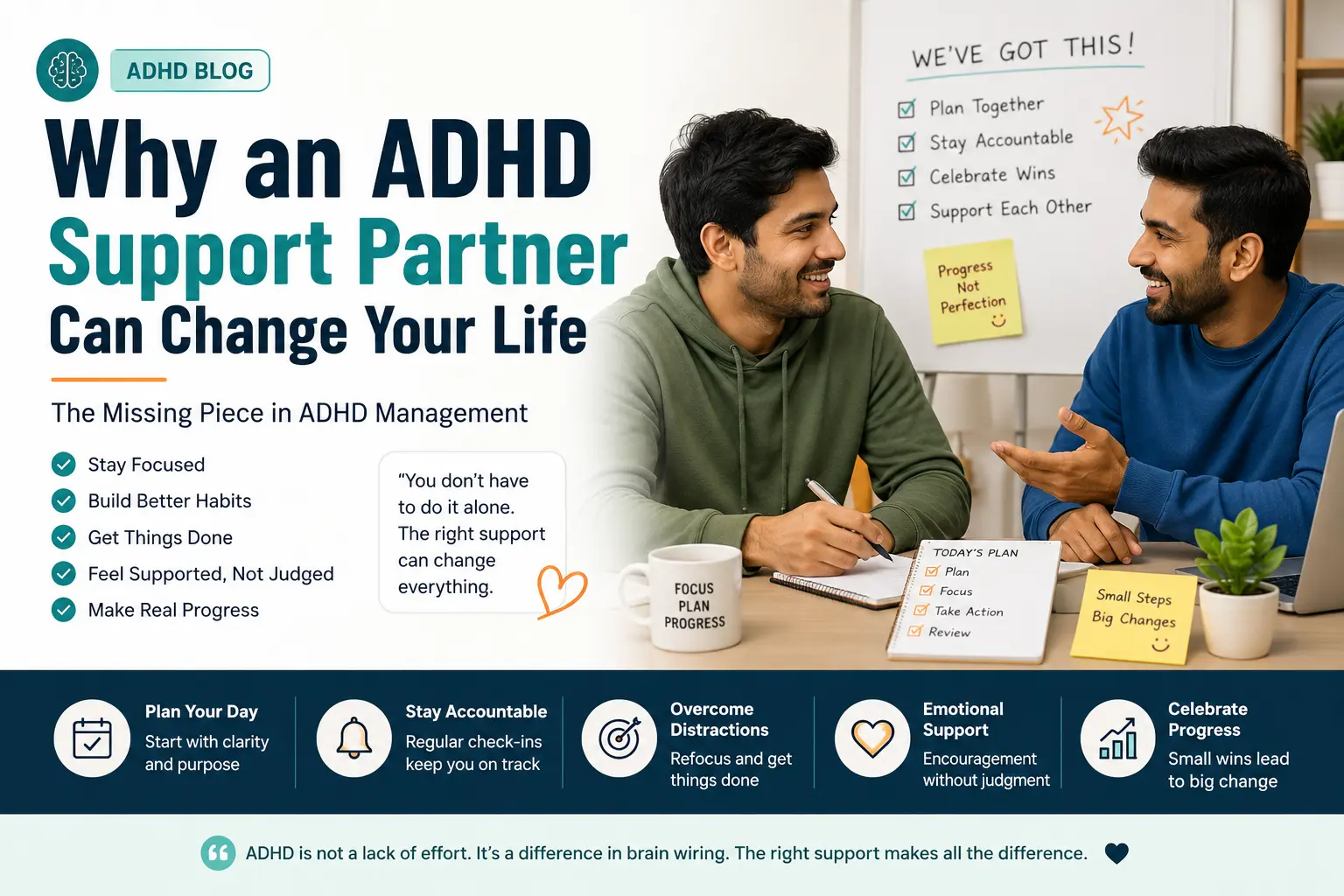
Why an ADHD Support Partner Can Change Your Life: The Missing Piece in ADHD Management
Quick Summary
If you have ADHD, you’ve probably heard advice like:
- “Just make a to-do list.”
- “You need more discipline.”
- “Try harder.”
- “Stop procrastinating.”
The truth is that most people with ADHD already know what they need to do. The real challenge is doing it consistently.
This is where an ADHD Support Partner can make a life-changing difference.
An ADHD Support Partner isn’t someone who controls your life. They help you stay focused, organized, motivated, and accountable—especially on the days when ADHD feels overwhelming.
Living with ADHD Is More Than Forgetfulness
ADHD affects much more than attention.
It can affect almost every part of daily life:
- Missing important deadlines
- Forgetting appointments
- Starting projects but never finishing them
- Feeling overwhelmed by simple tasks
- Constant procrastination
- Difficulty maintaining routines
- Emotional ups and downs
- Low self-confidence
- Feeling guilty for “not doing enough”
Many people spend years blaming themselves.
The reality is that ADHD affects the brain’s executive functions—the mental skills responsible for planning, organizing, prioritizing, and following through.
This is why simply “trying harder” usually doesn’t solve the problem.
Why ADHD Makes Everyday Tasks Feel So Difficult
People without ADHD often assume motivation comes first.
For many people with ADHD, motivation comes after starting.
The challenge is getting started.
Imagine needing to clean your room.
“I’ll clean it now.”
Someone with ADHD may think:
“Where do I begin?
Should I first pick up clothes?
Maybe I should vacuum first.
Actually, I should wash the dishes first.
Wait—I forgot to reply to that email.”
Thirty minutes later…
Nothing has been done.
This isn’t laziness.
It’s executive dysfunction.
What Is an ADHD Support Partner?
An ADHD Support Partner is someone who helps you bridge the gap between knowing and doing.
They don’t replace doctors or therapists.
Instead, they provide practical day-to-day support.
Their role may include:
- ✅ Helping you plan your day
- ✅ Breaking overwhelming tasks into smaller steps
- ✅ Checking in regularly
- ✅ Sending reminders
- ✅ Helping you refocus after distractions
- ✅ Celebrating small wins
- ✅ Listening without judgment
- ✅ Keeping you accountable
Think of them as your external executive function.
Why Accountability Works So Well for ADHD
One interesting fact about ADHD is that many people perform better when someone else is involved.
This is known as external accountability.
For example:
You may delay cleaning your room for two weeks.
But if a friend says,
“I’ll call you in 20 minutes and we’ll clean together,”
you suddenly get started.
Nothing about the task changed.
What changed was accountability.
This is why many people with ADHD become highly productive when working with:
- Coaches
- Body doubles
- Accountability partners
- Study partners
- Coworkers
Someone else’s presence helps activate focus.
The Science Behind Support
Research shows that ADHD is associated with differences in executive functioning, including:
- Planning
- Organization
- Working memory
- Time management
- Self-monitoring
- Emotional regulation
These challenges often improve when people use external systems rather than relying only on memory or willpower.
Examples include:
- Calendars
- Visual reminders
- Timers
- Daily planning
- Regular check-ins
- Accountability
An ADHD Support Partner combines many of these strategies into one supportive relationship.
What an ADHD Support Partner Can Help With
Morning Planning
Instead of waking up feeling overwhelmed,
they help answer:
“What are the three most important things today?”
This reduces decision fatigue.
Breaking Down Big Tasks
Instead of:
Build my business
They help create:
- Reply to five emails
- Finish homepage text
- Call one client
- Upload one blog
Small tasks feel achievable.
Regular Check-ins
Sometimes all you need is a simple message.
“How’s your progress?”
That one question can interrupt hours of procrastination.
Helping You Restart
Everyone gets distracted.
The difference is returning to the task.
A support partner gently helps you reset without criticism.
Emotional Support
ADHD often comes with shame.
People hear things like:
“You never finish anything.”
“You always forget.”
“You have so much potential.”
Over time, these comments hurt confidence.
A good support partner doesn’t judge.
They understand ADHD and encourage progress instead of perfection.
What an ADHD Support Partner Is NOT
Many people confuse support with control.
A support partner is not:
- ❌ A parent
- ❌ A boss
- ❌ Someone who constantly nags
- ❌ Someone who makes decisions for you
Instead, they work with you—not over you.
The goal is independence, not dependence.
Who Can Benefit Most?
An ADHD Support Partner may be especially helpful if you:
- Frequently procrastinate
- Miss deadlines
- Forget appointments
- Feel overwhelmed easily
- Start many projects without finishing them
- Work from home
- Run your own business
- Are preparing for exams
- Have trouble maintaining routines
- Feel isolated because of ADHD
Support is valuable at any age—from students to professionals to retirees.
Real-Life Example
Imagine Rahul, a freelance graphic designer with ADHD.
Every morning he creates a long to-do list.
By evening he has completed almost nothing.
Not because he isn’t capable.
Because he spent hours switching between tasks.
After working with an ADHD Support Partner, his routine changes.
Each morning they spend ten minutes planning.
His list is reduced to three priority tasks.
He receives a midday check-in.
When he gets distracted, he resets instead of giving up.
After a month:
- More work completed
- Less stress
- Better sleep
- More confidence
- Happier clients
Rahul didn’t suddenly become “more disciplined.”
He finally had the support system his brain needed.
Why This Matters in India
Awareness of ADHD in India is growing, but practical day-to-day support remains limited.
Many people have access to:
- Diagnosis
- Medication
- Therapy
But they still struggle between appointments.
They need someone who understands daily ADHD challenges.
A Support Partner fills that gap by providing consistent encouragement, accountability, and structure in everyday life.
Building Better Habits Together
Habits are difficult for anyone.
For people with ADHD, they can feel almost impossible without support.
A partner can help you build routines one step at a time:
- Morning planning
- Exercise
- Healthy eating
- Taking medication
- Sleep schedule
- Drinking enough water
- Studying
- Managing finances
Small daily actions create lasting change.
Progress, Not Perfection
Many people with ADHD believe they must become perfectly organized overnight.
That rarely happens.
Real progress looks like:
- Completing one important task today.
- Remembering one appointment.
- Exercising twice this week instead of zero times.
- Finishing a project that usually gets abandoned.
These small wins add up.
An ADHD Support Partner helps you notice and celebrate them instead of focusing only on setbacks.
Final Thoughts
Living with ADHD doesn’t mean you lack intelligence, ambition, or potential. It means your brain often needs different tools and more external structure than others.
An ADHD Support Partner isn’t about someone taking over your life—it’s about having a teammate who helps you stay on track, especially during the moments when ADHD makes it hardest to move forward.
Whether your goals are succeeding at work, building a business, studying for exams, improving relationships, or simply feeling less overwhelmed, consistent support can make those goals more achievable.
You don’t have to face ADHD alone. With the right systems, encouragement, and accountability, lasting progress is possible—one small step at a time.
Frequently Asked Questions (FAQ)
Is an ADHD Support Partner the same as an ADHD coach?
Not exactly. A coach often focuses on long-term strategies and skill development, while a support partner provides regular day-to-day accountability, reminders, and encouragement. Some services may combine both roles.
Do I still need medication or therapy?
An ADHD Support Partner complements—not replaces—medical care or therapy. If you have a diagnosis or concerns about ADHD, consult a qualified healthcare professional for evaluation and treatment.
Can support be provided remotely?
Yes. Many people benefit from support through WhatsApp, phone calls, video meetings, or messaging apps, making it accessible from anywhere.
How often should I check in with a support partner?
It depends on your needs. Some people prefer one daily check-in, while others benefit from morning planning plus a short afternoon follow-up.
Ready to Experience ADHD Support?
If you’ve been struggling to stay consistent despite your best efforts, you don’t have to do it alone.
We’re building an ADHD Support Partner service designed specifically for people with ADHD in India. As part of our Founding Members Program, you’ll receive personalized support, daily accountability, and the chance to help shape a service built by and for the ADHD community.
Take the first step today—because sometimes the right support is the difference between staying stuck and moving forward.
