
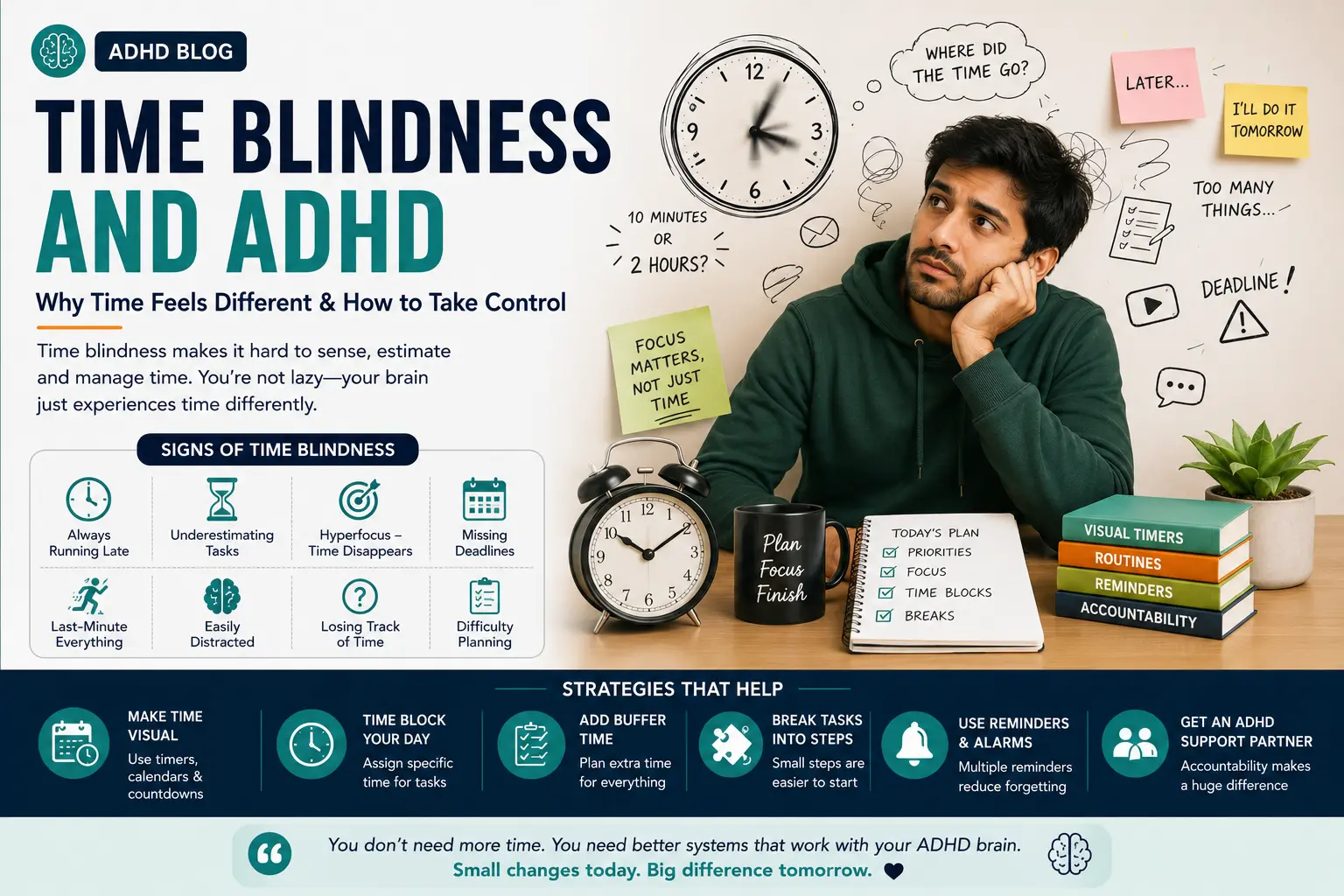
Time Blindness and ADHD: Why Time Feels Different
Have you ever looked at the clock and wondered,
“Where did the last two hours go?”
Or maybe you’ve said:
“I’ll leave in five minutes.”
“This task will only take ten minutes.”
“I still have plenty of time.”
Then suddenly you’re late again.
If this sounds familiar, you may be experiencing
time blindness, a common term used to describe
difficulties with sensing, estimating, and managing time that can
occur alongside ADHD.
Time blindness doesn’t mean you can’t tell time. It means you may
struggle to accurately feel, estimate, and manage the passage of time.
For many people with ADHD, time can feel unpredictable. Minutes
disappear, deadlines seem to arrive suddenly, and planning can become
much harder than expected.
This article is for educational purposes only and is not a diagnosis.
If you think you may have ADHD or are concerned about time-management
difficulties, consider speaking with a qualified healthcare professional.
Quick Summary
People with ADHD and time-related difficulties may:
- Frequently arrive late
- Underestimate how long tasks take
- Lose track of time while working
- Miss deadlines
- Forget appointments
- Struggle to plan their day
- Wait until the last minute to start important work
- Become deeply absorbed in activities for long periods
The good news is that time-management difficulties can often be
improved with practical tools, routines, and external support.
What Is Time Blindness?
Time blindness is a term commonly used to describe difficulty sensing,
estimating, and managing time.
Unlike a clock, your brain doesn’t automatically tell you:
- How much time has passed
- How long something will take
- How much time remains before a deadline
Instead, some people with ADHD experience time primarily as what is
happening now versus what has not happened yet.
Now
The present moment and whatever currently feels important,
interesting, or urgent.
Not Now
Tomorrow, next week, or a future deadline may feel distant until
the event becomes more immediate.
Why Does ADHD Cause Time Blindness?
ADHD can affect executive functions involved in planning,
organization, prioritization, monitoring progress, shifting attention,
and estimating how long tasks may take.
As a result, some people with ADHD may:
- Misjudge how long tasks will take
- Forget future commitments
- Lose awareness of time while concentrating
- Delay action until urgency increases
These challenges are not necessarily a sign of laziness or a lack
of caring. They can reflect difficulties with executive functioning
and self-management.
Common Signs of Time Blindness
Always Running Late
You genuinely intended to leave on time.
Then one more email, one quick message, or one small task takes
longer than expected.
Suddenly, you’re 20 minutes late.
Underestimating Tasks
You think:
“I’ll finish this in 15 minutes.”
But the task actually takes 45 minutes or even two hours.
Repeatedly underestimating tasks can create schedules that are
difficult or impossible to follow.
Hyperfocus
Sometimes ADHD can involve the opposite experience.
You become deeply absorbed in an activity that is particularly
interesting or rewarding.
- Gaming
- Work
- Reading
- Coding
- Art
- Social media
Several hours may pass before you realize how much time has gone by.
Missing Deadlines
Assignments, bills, renewals, and work projects can feel far away
until the deadline suddenly becomes urgent.
This can create a cycle of last-minute work and unnecessary stress.
Waiting Until the Last Minute
Some people with ADHD find it difficult to begin important work
until immediate pressure creates enough urgency to get started.
This does not necessarily mean they enjoy working under stress.
Losing Track of Daily Time
You sit down to check one notification.
Thirty minutes later, you are watching unrelated videos.
Another hour passes and the original task is forgotten.
Difficulty Planning the Day
Creating a schedule may seem easy, but following it can be much harder.
Unrealistic time estimates can cause tasks to overlap and leave
you feeling behind by the afternoon.
How Time Blindness Affects Everyday Life
Work
- Missing meetings
- Submitting projects late
- Feeling constantly rushed
- Forgetting deadlines
- Staying late to catch up
Over time, these challenges can affect confidence and work performance.
Relationships
Friends or family members may become frustrated when someone is
consistently late or forgets important events.
Time-management difficulties do not necessarily mean that you
don’t value the people around you.
Finances
- Late payments
- Missed renewal dates
- Forgotten subscriptions
- Unplanned purchases
External reminders and automated systems can help reduce these problems.
Health
Some people may forget or delay:
- Taking prescribed medication
- Eating regular meals
- Drinking water
- Exercising
- Going to sleep on time
- Attending appointments
If health-related reminders are difficult to manage, practical
systems and professional guidance can be helpful.
What Time Blindness Feels Like
Some adults describe the experience as:
“I know the clock says an hour has passed, but it feels like five minutes.”
“Tomorrow doesn’t feel real until it becomes today.”
These experiences can be confusing and frustrating. Understanding
the pattern can be the first step toward creating systems that
make time easier to manage.
How to Manage Time Blindness
Use Multiple Alarms
Instead of relying on one reminder, use several alarms for different
stages of an activity.
- Start preparing
- Leave home
- Meeting starts
Each alarm creates an external reminder that helps make time more visible.
Make Time Visible
Consider using tools such as:
- Analog clocks
- Digital timers
- Countdown apps
- Visual timers
Seeing time pass can make it easier to maintain awareness while
completing a task.
Time-Block Your Day
Instead of simply writing:
Finish report
Give the task a specific time block:
Work on report
Giving tasks a specific place on your calendar can make your
schedule more concrete.
Add a Buffer
If you think something will take 20 minutes, consider planning
30 to 35 minutes.
Building extra time into your schedule can reduce stress and
make plans more realistic.
Break Large Tasks Into Small Steps
Instead of:
Clean the house
Try:
- Pick up clothes — 10 minutes
- Wipe kitchen counters — 15 minutes
- Vacuum living room — 20 minutes
Smaller tasks are often easier to start and estimate.
Use an ADHD Support Partner
Some people benefit from external accountability and support.
A support partner can help with:
- Planning the day
- Setting priorities
- Checking progress
- Providing reminders
- Maintaining accountability
External support can help compensate for difficulties with
internal time management.
Review Your Day
Spend five minutes each evening asking:
- What took longer than expected?
- What distracted me?
- What worked well?
- How can I plan better tomorrow?
Over time, reviewing your estimates can help you create more
realistic schedules.
Real-Life Example: Managing Time Blindness With ADHD
Imagine Priya, a software developer with ADHD.
Every morning she creates a long to-do list and expects to finish
everything by 5 PM.
Instead:
- Meetings run longer than expected
- She becomes deeply focused on one bug for several hours
- She forgets lunch
- The remaining tasks stay unfinished
After learning about time-management difficulties, she changes
her approach.
- Uses a visual timer
- Plans only three major tasks each day
- Adds 15-minute buffers
- Sets reminder alarms
- Checks in with an accountability partner
Within a few weeks, she isn’t necessarily working harder.
She is using systems that better match the way she manages attention
and time.
You’re Not Lazy: Your Brain Experiences Time Differently
People with ADHD may hear:
- Be more responsible.
- Manage your time better.
- You’re always late.
These comments can create shame and frustration.
Understanding time-related difficulties can change the conversation.
Instead of relying only on willpower, you can build external systems
that make time easier to see and manage.
Final Thoughts
Time-related difficulties are common among people with ADHD and can
affect work, relationships, finances, and everyday routines.
The goal isn’t to develop a perfect sense of time. Instead, create
an environment that makes time more visible and manageable.
Calendars, timers, reminders, routines, buffers, and supportive people
can help bridge the gap between intention and action.
Progress won’t happen overnight, but small changes can make a meaningful
difference. With the right strategies, you can reduce stress, manage
commitments more consistently, and feel more in control of your day.
Frequently Asked Questions About Time Blindness and ADHD
Is Time Blindness an Official ADHD Symptom?
Time blindness is not listed as a separate diagnostic criterion
for ADHD. However, time-related difficulties are commonly discussed
in connection with the executive-function challenges that can occur
with ADHD.
Does Everyone With ADHD Have Time Blindness?
No. Time-related difficulties can vary significantly from person
to person, and not everyone with ADHD experiences them to the
same degree.
Can Medication Help With Time Blindness?
For some people, ADHD medication prescribed by a healthcare
professional may improve attention and executive functioning,
which can indirectly support time management. Medication is only
one part of a comprehensive treatment plan.
Can You Overcome Time Blindness?
You may not eliminate time-related difficulties completely,
but practical tools such as visual timers, calendars, reminders,
routines, and external accountability can help you manage them
more effectively.
Take the Next Step
If you constantly feel like time is slipping away despite your best
efforts, you’re not alone.
Start small: use a timer, schedule fewer tasks, add a buffer to
your plans, and consider seeking appropriate support if you need it.
Building systems that match the way you manage attention and time
can help you spend less time feeling overwhelmed and more time
making meaningful progress.
